


Ipari hírek
Otthon / Hírek / Ipari hírek / Explosion-Proof Drying Oven: How It Works and How to Choose the Right One
Explosion-Proof Drying Oven: How It Works and How to Choose the Right One
Dátum: Jun 10, 2026
Why Standard Ovens Fail in Flammable Environments
Every fire or explosion needs three things: fuel, oxygen, and an ignition source. In a standard drying oven, all three can coexist. The moment a flammable solvent — acetone, ethanol, toluene, or lithium electrolyte — begins to evaporate inside a conventional chamber, the vapors mix with ambient air and only need a spark to ignite. That spark can come from a relay switching, a motor brush arcing, or even static discharge from the fan blade.
This is not a theoretical risk. Solvent fires in laboratory and industrial drying operations are one of the most common causes of equipment loss and facility damage in chemical and pharmaceutical environments. A conventional oven offers zero protection against this. Its electrical components are open to the atmosphere inside the chamber, its motor is not sealed, and its enclosure is not designed to contain — let alone suppress — any pressure event.
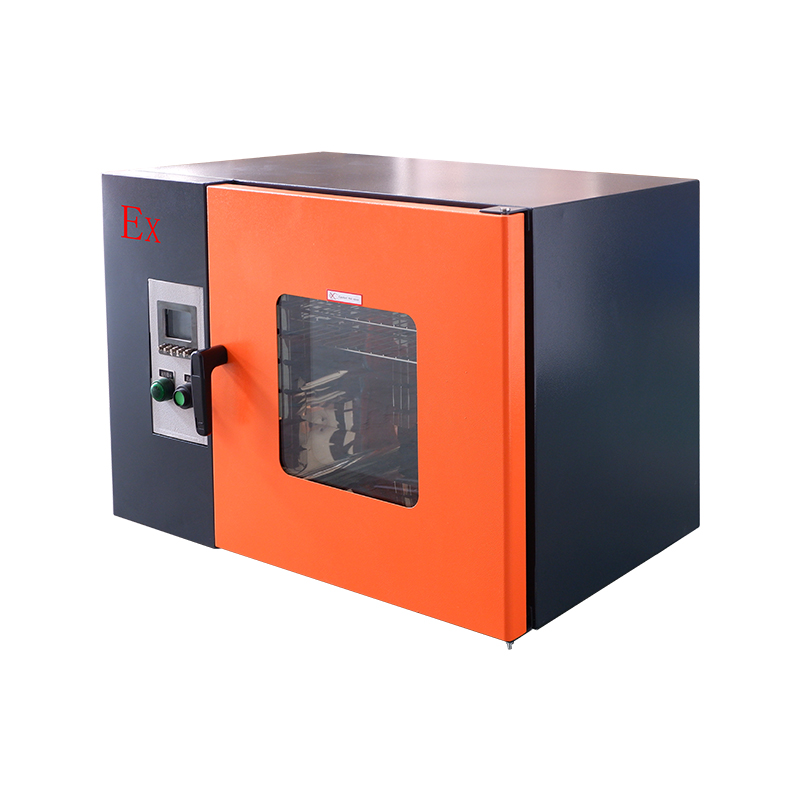
An explosion-proof drying oven is built specifically to break that ignition chain. It does not simply add a warning label; it re-engineers every potential ignition source inside the unit.
How an Explosion-Proof Drying Oven Actually Works
The protection logic of an explosion-proof drying oven operates on two parallel tracks: eliminating ignition sources inside the chamber, and safely managing pressure if something does go wrong. Different models combine these mechanisms in different ways, but the core technologies are consistent across the category.
Explosion-Proof Electrical Components
Every electrical element that could produce a spark — heaters, switches, motors, junction boxes, conduit — is replaced with certified explosion-proof (XP-rated) equivalents. These components are housed in sealed enclosures that can withstand an internal arc without transmitting flame to the surrounding atmosphere. The fan motor, which runs continuously and generates heat, is fully enclosed and uses long-shaft designs to keep the motor body outside the working chamber entirely.
Explosion Relief Windows and Pressure Venting
Should pressure build up unexpectedly inside the chamber — due to rapid solvent evaporation or a localized ignition event — the oven needs a controlled release path. Explosion relief windows (typically mounted on the rear panel) are engineered to open automatically when internal pressure exceeds ambient. More advanced configurations add a pressure measurement device: the relief window triggers only when a sensor confirms pressure has crossed a preset threshold, offering more precise control than passive venting alone.
Nitrogen Inerting and Positive-Pressure Systems
Some explosion-proof drying ovens go further by removing oxygen from the equation entirely. A nitrogen filling system continuously injects inert gas into the chamber, maintaining a slightly positive internal pressure above the surrounding atmosphere. This prevents external air — and with it, oxygen — from infiltrating the chamber. explosion-proof vacuum drying ovens that combine low-pressure environments with solvent removal take a complementary approach: by reducing pressure below atmospheric, they lower the boiling point of solvents and evacuate vapors before concentrations can reach dangerous levels.
Smooth Internal Airflow Design
Even airflow management matters. Turbulent or stagnant zones inside the chamber can allow vapor to accumulate in pockets, raising local concentration above the lower explosive limit (LEL). Well-designed explosion-proof ovens use carefully engineered air circulation paths — typically single-side vertical or horizontal blowing — with large exhaust volumes to continuously dilute and evacuate solvent-laden air.
Class A Oven vs. Explosion-Proof Oven: What's the Difference
These two terms are frequently used interchangeably, but they describe different engineering approaches governed by different standards. Understanding the distinction helps you ask the right questions when specifying equipment.
| Feature | Class A Oven (NFPA 86) | Explosion-Proof Oven (NFPA 70 / NEC) |
|---|---|---|
| Governing standard | NFPA 86 | NFPA 70 (National Electrical Code) |
| Primary protection method | Ventilation — dilutes vapors below LEL | Ignition elimination — XP-rated all electrical parts |
| Suitable for flammable solvents | Yes, with adequate fresh-air purging | Yes, even with high solvent loads |
| Oxygen present in chamber | Yes | Yes (unless combined with N₂ inerting) |
| Typical cost | Moderate | Higher (due to XP-rated components) |
| Common applications | Paint curing, coating drying | Pharmaceutical synthesis, lithium battery, chemical R&D |
A Class A oven manages the fuel-to-air ratio through ventilation, keeping vapor concentrations below 25% of the LEL as required by NFPA 86. An explosion-proof oven, regulated under NFPA 70, takes the complementary approach: it assumes vapors may be present and ensures there is no ignition source capable of triggering them. In high-risk pharmaceutical or chemical synthesis environments, the two approaches are often combined in a single unit.
Industries That Rely on Explosion-Proof Drying Ovens
The need for explosion-proof drying equipment cuts across a wide range of sectors, each with its own regulatory requirements and process demands.
- Pharmaceutical synthesis: API drying routinely involves organic solvents — methanol, isopropanol, dichloromethane — with low flash points. GMP environments also demand cleanable surfaces and validated temperature uniformity, requirements that well-engineered explosion-proof ovens are built to meet.
- Lithium battery manufacturing: Electrode drying and electrolyte handling involve highly flammable materials in a process where even a minor ignition event can cause catastrophic cell failure. Explosion-proof ovens with precise temperature control are standard equipment in this sector.
- Petrochemical and chemical R&D: Sample preparation, catalyst drying, and resin curing all involve materials that off-gas flammable vapors at elevated temperatures. Lab-scale explosion-proof ovens provide a safe platform for small-batch work before scale-up.
- Aerospace and military: Specialty coatings, adhesives, and composite materials used in these industries often require controlled curing under conditions that would be hazardous in standard equipment.
- Hazardous chemical storage and testing: Quality control labs handling flammable reagents need equipment certified for use in classified locations, particularly when ovens are installed in or adjacent to hazardous-area zones.
For a full view of available configurations — from forced-air models to vacuum and constant temperature/humidity variants — see our complete explosion-proof instruments and equipment series.
Key Specifications to Evaluate Before Buying
Not all explosion-proof drying ovens are equivalent. The right choice depends on your process conditions, the solvents involved, and the regulatory environment you operate in. Here are the specifications that matter most.
Temperature Range and Uniformity
Most explosion-proof drying ovens operate from room temperature to 200°C or 300°C. Uniformity within the chamber — typically ±1–2°C in a properly loaded oven — is critical for reproducible results, especially in pharmaceutical and R&D applications. Check whether uniformity ratings are specified for loaded or empty conditions, as the difference can be significant.
Ventilation and Exhaust Volume
The exhaust pipe diameter and air circulation rate determine how quickly the oven can dilute and remove solvent vapors. For high-solvent-load processes, a large exhaust volume (with a pipe diameter of 150mm or more at high flow) is essential. Models designed for fresh-air-only supply — rather than recirculating internal air — offer inherently safer performance when processing large quantities of volatile material.
Explosion Protection Method
Confirm exactly which protection mechanisms are built in: explosion-proof electrical components only, passive pressure-relief windows, active pressure-sensor-triggered venting, or nitrogen inerting. Each adds a layer of safety but also cost and operational complexity. Match the protection level to your actual risk profile rather than defaulting to the most expensive option.
Certification and Compliance
For equipment sold into regulated industries, look for units that carry relevant certifications — CNAS, ATEX (for European markets), or compliance with NFPA 70/86 for North American applications. Certification documentation is also typically required by insurers and during facility audits.
Chamber Material and Cleanability
Stainless steel interiors are standard for pharmaceutical and food-adjacent applications. For processes involving corrosive solvents, verify the material compatibility of seals, shelving supports, and any internal sensors. Easy disassembly for cleaning is worth specifying upfront rather than discovering it is absent after installation.
Our forced air drying oven with full explosion-proof design is a strong starting point for most industrial drying applications, with robust alloy construction and configurable exhaust options.
Choosing the Right Partner for Explosion-Proof Equipment
An explosion-proof drying oven is not a commodity purchase. The quality of the sealing components, the integrity of the XP-rated electrical system, and the reliability of the pressure-relief mechanism all determine whether the equipment actually performs as certified under real process conditions.
Shanghai Dengsheng Instrument Manufacturing has built explosion-proof laboratory equipment for customers across petrochemicals, pharmaceutical manufacturing, aerospace, and hazardous chemical research. Our units are manufactured to certified standards, with intelligent control systems that integrate temperature sensors, pressure monitors, and fault self-diagnosis for continuous safety monitoring.
If you are specifying explosion-proof drying equipment for a new process or replacing aging units, contact our team for a technical consultation. We will help you match the right protection level, chamber size, and certification package to your exact requirements.
Üzenet küldése
Ajánlott termékek
A híres vállalatok által kínált termékekben a felhasználók mélyen megbíznak.

- KAPCSOLAT
-
- No. 119, Qingliang Avenue, Yaozhuang Town, Zhejiang, China.
- [email protected] ( Email )
- +86-13671719019 ( Phone )
- +86-021-57440136 ( Tel )
- TERMÉK
-
- Szárító sütő sorozat
- Vákuum doboz sorozat
- Robbanásbiztos sorozat
- Magas hőmérsékletű kemence sorozat
- Inkubátor sorozat
- Tesztkamra sorozat
- Egyéb sorozatok
- Légszárító sütő
- Ellenállás kemence
- Vákuumcsöves kemence
- Penész inkubátor
- Vákuumos légköri kemence
- Biokémiai inkubátor
- Szén-dioxid inkubátor
- Robbanásbiztos vákuumszárító sütő
- Magas és alacsony hőmérsékletű tesztkamra
- MOBIL
Szerzői jog ©
Shanghai Dengsheng Instrument Manufacturing Co., Ltd.
Minden jog fenntartva. Laboratóriumi berendezések gyártói

 Vissza az elejére
